
For years, Europe has been criticised for moving too slowly. Too much regulation. Too much engineering. Products that take longer to build and longer to sell. Compared to Silicon Valley, that often looked like a weakness.
But what if we have been looking at the wrong scoreboard? As AI reshapes entire industries and geopolitical resilience becomes an economic priority, many of Europe's perceived disadvantages are starting to look remarkably like competitive advantages.
There is a version of the European tech story that gets repeated at conferences, in pitch feedback sessions, and in op-eds written by investors observing the continent from a distance. European founders think too small, move too slow and over-engineer everything.
The implication is obvious: Europe is a nice place to start a company, but if you want to build something that truly matters, you eventually need to act more like Silicon Valley. It is a confident take, but it is also increasingly wrong…
Europe spent years playing someone else's game
If we are honest, Europe has often looked at Silicon Valley with a mixture of admiration and insecurity. The global startup playbook rewarded speed above almost everything else. Investors chased businesses that could launch quickly, scale globally and reach millions of users before anyone else noticed.
Consumer software, SaaS, and marketplace models naturally became the benchmark for what a successful startup should look like. Europe tried to compete on those terms. Sometimes successfully, often not. But perhaps the bigger mistake was assuming those were the only rules worth playing by.
Mario Draghi's report on European competitiveness makes a compelling observation. Europe's challenge has never been a lack of talent, engineering capability or scientific excellence. The real problem has been turning those strengths into globally competitive companies and giving them access to enough capital to scale.
Between 2008 and 2021, almost 30% of Europe's unicorns moved their headquarters abroad, most of them to the United States.
The world has become much more interested in hard things
Something has changed over the last few years. The sectors generating some of the most durable value today are not the ones that reward the old move fast and break things logic. They reward almost the opposite — the ability to operate in regulated environments, build technology that integrates with complex industrial systems, and earn trust from enterprise customers who care more about reliability than novelty.
Energy transition, industrial automation, advanced manufacturing, and infrastructure software are not categories where you want your vendor to iterate recklessly. These are markets where a broken product is not a funny bug report. It can stop a production line, create safety risks, increase costs, or damage critical infrastructure. In that world, over-engineering is not always a bug. Sometimes it is the product.
The shift is showing up in the numbers. According to the 2026 European Deep Tech Report published by Lakestar, Walden Catalyst and Dealroom, deeptech investment in Europe reached $20.3 billion in 2025, representing a record 32% of all European venture capital. That is more than double its share from a decade ago. While the broader European tech market remains well below its 2021 peak, deep tech funding is now only 4% below its all-time high.
Capital is rotating from software to science, and this looks much more structural than cyclical. The same report points to something Europe should probably talk about with more confidence.
The continent is home to 30% of the world’s top deeptech universities and produces twice as many science and engineering graduates as the United States. That talent base is now translating into company creation at a scale that was much less visible a decade ago. Nearly 80 European deeptech spinouts had crossed the billion-dollar valuation or hundred million dollar revenue threshold by the end of 2025.
These are not cottage industry numbers. The enterprise value of VC-backed European deeptech companies has reached $690 billion, up from $73 billion in 2015. That is a nearly tenfold increase in a decade.
The old story of Europe as a place that produces great research but cannot commercialise it is not entirely false, but it is becoming harder to repeat with a straight face.
Complexity is a moat, not a handicap
Here is the part that the standard critique often misses. In the sectors that may define the next decade of economic value, such as energy, industrial AI, and advanced infrastructure, the ability to navigate complexity is not a weakness to be overcome. It is the core competitive advantage.
Consider what it actually takes to sell into a European utility, a Tier 1 automotive supplier or a multinational industrial manufacturer.
You need to understand procurement cycles that run eighteen months, not eighteen days; you need a product that integrates with systems built years before your startup existed; you need to comply with regulatory frameworks that vary across markets; you need to survive due diligence from engineers who have seen every vendor promise under the sun.
A startup that has learned to operate in that environment has built something that a well-funded competitor from San Francisco may need years to replicate, if they bother at all. This is not an argument for bureaucracy, but for the friction European founders learn to navigate in their home markets can become a source of defensibility at scale.
The complexity that looks like a disadvantage during an early fundraising conversation may become the moat once the customer base is established.
Investors are changing the way they look at hard tech
Part of the problem has also been on the investor side.
For a long time, too much European venture capital borrowed US frameworks and applied them to sectors where those frameworks did not always work. Seed-stage energy startups were evaluated like SaaS companies. Industrial automation founders were told their sales cycles were too long. Deeptech teams were penalised for having more PhDs than growth marketers on the founding team.
That is starting to change. A new generation of funds is building differently — by developing the sector knowledge required to evaluate hard tech opportunities on their own terms, understanding what a grid balancing algorithm actually does, knowing why an eighteen-month sales cycle in the energy sector reflects the structure of the market rather than a weakness in the business, and recognising that a founder with deep industrial experience and one serious enterprise customer can be a more interesting pre-seed bet than a team of generalists with a polished deck and no domain knowledge.
Hard tech does not need patient capital as an excuse for weak businesses. It needs informed capital that knows what real progress looks like before it appears in a standard dashboard.
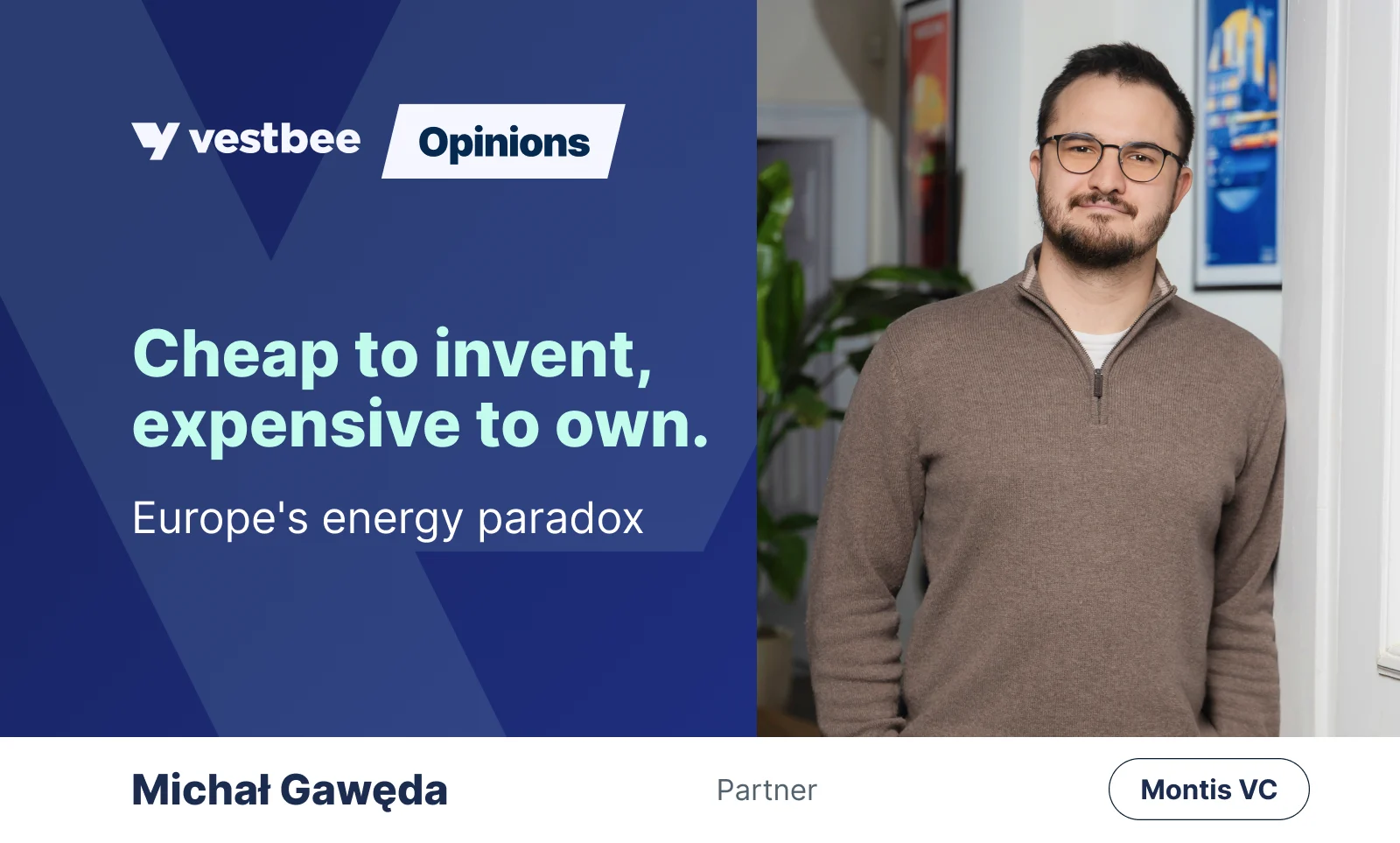
At Montis VC, this is the lens we apply. Many of the founders we back do not describe themselves as AI startups. They are industrial companies, energy businesses, and infrastructure builders that use AI as an enabling layer rather than a product in itself. The next generation of European category leaders may come from solving problems worth billions of euros inside the continent's factories, power grids, and logistics networks.
Those companies may not have the loudest launches or the most viral product demos. But if they work, they tend to become very difficult to replace. That kind of defensibility is what happens when deep engineering, industrial knowledge, and genuine domain experience compound over time.
Europe should stop apologizing
Europe does not need to become a better version of Silicon Valley. It should become a better version of itself. That means embracing the sectors where it already has structural advantages instead of constantly comparing itself to ecosystems built around entirely different strengths.
Hard tech, industrial AI, energy systems, advanced manufacturing, and critical infrastructure are not consolation prizes because Europe missed the consumer internet. They are becoming some of the most strategically important markets in the global economy.
For years, Europe apologized for building hard things. It may turn out that hard things are exactly what the world needs most.