
If you're tired of the constant churn of algorithmic feeds, incessant AI headlines, billionaire feuds, and media discourse that's lost all its nuance, you're not alone.
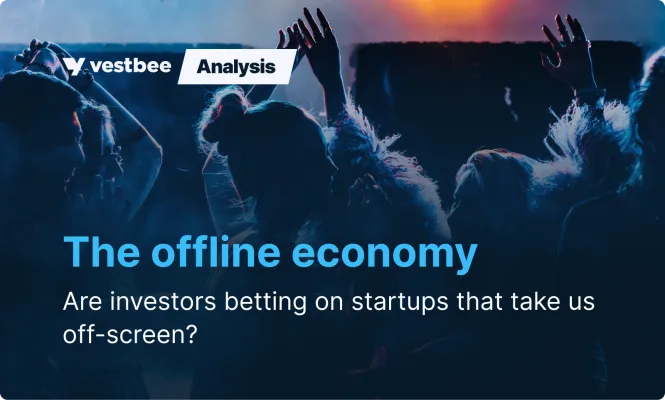
At Vestbee, we've been watching a growing number of lifestyle and consumer startups come through our platform with a similar pitch: they build tech to get people off tech, technology to be used offline.
These are products whose success metric seems to be time well spent away from the screen: out of the house, at the event, in a restaurant, while traveling, even in a villa somewhere in Sicily rented through an app. Simply put, in front of another human being.
It is a strange moment for this thesis to gain traction, as 2026 was supposed to be the year AI ate everything. Instead, some of the more interesting early-stage funding activity in Europe is happening in businesses that deliberately do less with technology, not more.
Is offline the new luxury?
The fact that people are tired of their phones is now backed by data and trend monitoring. Searches for "screen fatigue" climbed 255% over the past year. Searches for "digital detox", the presumed antidote, rose 58% over the same period.
Pew Research Center has found that 62% of young adults aged 18 to 29 report being online almost constantly. In another poll, 62% of respondents said they actively hate how much time they lose to their phones.
CNBC reported in March 2026 on the rise of "going analog," a phrase that achieved genuine social media virality. It described young people spending time and money on what seem like old-school hobbies such as crafting, drawing, and sewing.
Chess clubs are being described as "the new nightclubs”, vinyl is in its sixteenth consecutive year of sales growth, and even flip phones appear to be making a return.
The underlying diagnosis, echoed across nearly every corner of this conversation, is some version of algorithmic and cognitive overload: an AI-saturated information environment that leaves people hungry for real life, offline experiences and human interaction.
Startups are catching up
European founders, both on and beyond the Vestbee platform, are increasingly building products around these needs. They are moving into a niche of “lifestyle tech” that responds to social trends not by introducing another AI algorithm, but by actually encouraging people to get out of the house.
We mapped some of the startups that raised funding during 2024-2026.
Anti-loneliness and IRL-meetup apps
This is the most crowded and most clearly formed category.
- Timeleft, founded in Paris in 2020, is an app that organizes weekly dinners for six strangers in restaurants worldwide, monetizing the matchmaking rather than the meal itself. It raised a $7M Series A in July 2024.
- Joiner App, founded in Vilnius in 2022, was inspired by the founder’s own experience of loneliness abroad during the COVID lockdown. It markets itself explicitly as an alternative to dating apps for people who want real-world plans, not matches. It has raised €2.2 million in total funding and has recently launched in Portugal, deliberately targeting countries with high reported levels of loneliness.
- CLIQ, founded in London in 2023, blends events, group chats, and brand-community marketing under an explicit "combat social isolation" banner. It has raised £1.5m across two rounds and passed 100,000 users.
There are also some more inventive or specialised versions of this theme.
- Poolhouse built an AI-powered, computer-vision pool table platform and raised $35.5 million in seed funding in April 2025, followed by $55 million in growth equity in July 2026.
- Flight Club, the "Social Darts" operator that pioneered the format in London in 2013, offers proof that these concepts can develop into durable businesses. Its revenue reached €96.9 million in 2024, up from €12 million in 2018.
- Wake The Tiger in Bristol, self-described as the "world's first Amazement Park," blends immersive art with experiential entertainment. Its revenue grew by 185% between 2022 and 2023. The company has raised €5.6 million through a funding stack combining VC-led seed rounds, a Crowdcube campaign, a Creative UK grant, and regional capital.
Nightlife and safety infrastructure
Getting people to choose to go out again requires addressing the anxiety that can keep them home.
- Where You At, a University of Cambridge spinout founded in 2020, built a real-time location-sharing and check-in app for nightlife safety. The company donates 5% of its profits to RAINN and the Good Night Out Campaign and has raised €4 million to date.
Third-place and community infrastructure
- Swurf, founded in Edinburgh in 2021, connects remote workers with underused café, bar, and hotel space. It is explicitly positioned as an antidote to remote-work loneliness, and is backed by Skyscanner co-founder Gareth Williams.
- Until, founded in London in 2019, runs a members' club and coworking space specifically for wellness professionals. It combines workspace with community and professional development and has raised €9.5 million, most recently closing an early-stage VC round in September 2025.
- native, founded in Brighton in 2015, connects 1.6 million UK students across 75-plus Students' Unions with advertisers. In practice, it is building infrastructure for campus community life.
The offline investment thesis
Pure software is easier and cheaper to build. AI has lowered the barrier to launching a web app, and that means defensibility increasingly has to come from somewhere else: proprietary data, operational complexity, trusted communities, or a foothold in the physical world.
Cody Candee, CEO of luggage-storage network Bounce, which raised a $19 million Series B led by Sapphire Sport, with Andreessen Horowitz and General Catalyst participating, put it in blunt founder terms:
"Companies that build in the offline world will be the next big wave of value creation in tech... If you start a company today that is pure software, there will be 50 competitors doing the same thing. Software is now cheap — AI can build it in moments.”
The offline economy is not really about rejecting technology. Most of these companies still rely on apps, algorithms, booking systems, and digital payments. The difference is where the actual value is created. And perhaps that is the investment thesis — as software becomes easier to build, the harder and more valuable part may be creating something people are willing to leave their phones for.