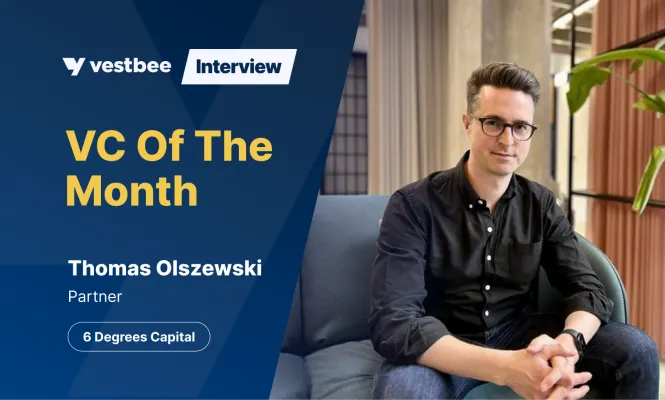

6 Degrees Capital is an early-stage venture capital fund based in London, UK, and Antwerp, Belgium. It has over 70 companies in its portfolio and now invests from a €154 million fund. The firm typically invests between €1 million and €7.5 million in addition to follow-on capital, focusing on AI, SaaS, and fintech companies across Europe and emerging markets.
Fund strategy overview
Geography: Europe and emerging markets
Preferred industries: AI, SaaS, and fintech
Investment ticket: €1–7.5M
Company stage: seed, Series A
Product type: Software
Product stage: live with customers and scaling
Revenues: $100k–5M
Q&A with Thomas Olszewski, Partner at 6 Degrees Capital
What are the 5 main things you look for in a startup?
This question is a bit like asking, “How do you do heart surgery?” There are no hard rules — venture capital is more art than a checklist — but there are a few principles we come back to.
- Founders with experience, conviction, and a real connection to the problem.
We are drawn to founders who are not only capable but strongly motivated by the market they’re going after. That motivation often comes from lived experience. For example, a data science solution for agriculture is far more compelling when the founder has worked in, grown up around, or otherwise understands farming. Without that connection, we tend to question how durable their interest — and resilience — will be over the next 5–10 years.
- Products that are hard to build.
We look for defensible products — technology, data, or execution advantages that are difficult to replicate. If something can be rebuilt quickly by a well-funded competitor, it’s unlikely to sustain long-term value. A real “moat” doesn’t have to be obvious on day one, but it should be clearly emerging.
- A clear niche the company can truly win.
Rather than chasing the biggest possible market on paper, we prefer companies that can dominate a specific niche. Being the clear winner in a focused segment is often far more powerful than being the third or fourth option in a massive market.
- Financials grounded in reality.
This sounds obvious, but it’s rare. We don't expect perfection, but we like to see numbers to reflect how the business actually works, not how someone wishes it worked.
- Momentum and rate of progress, not just headline ARR.
Founders often ask what level of ARR they need to reach to be considered for investment. In reality, the absolute number matters far less than momentum. What we care about is pace: how much ARR you’re adding each month, how consistently you’re growing, and whether that growth is accelerating. Those signals tell me far more than any single revenue milestone.
What disqualifies a startup as your potential investment target?
One of the frustrating realities of venture capital is how often we have to say “no.” Early in my career, that part of the job really grated on me. Over time, though, I’ve noticed the most experienced founders use every meeting as a chance to learn, sharpen their thinking, and build relationships — even when the outcome is a pass. I’ve tried to adopt the same mindset on the investor side.
In practice, a pass can happen for many reasons. If a company doesn’t meet the criteria around team, product, market, financial viability, or traction, any one of those can be disqualifying.
The hardest of these to assess and to communicate is low confidence in the team. Team fit is inherently subjective, and most VCs either can’t or don’t feel it’s appropriate to say directly, “We don’t believe this is the right team.” Instead, feedback is often redirected to something safer or more concrete — for example, “the market is too small.” While usually well-intentioned, this can create confusion for founders and break the feedback loop, making it harder for them to understand what actually needs to change.
What, in your opinion, differentiates the best founders from the rest?
What I’ve personally observed is that the best founders are talent magnets. They bring people together. Sometimes that means assembling a junior team of highly motivated, highly capable individuals. Other times, it means attracting senior industry experts. In every case, the common thread is the same: great founders are not sitting alone, crunching numbers in isolation. They are building teams, serving customers, and creating products people love.
The best founders are also deeply convincing and inspiring. They spend a huge amount of time on the phone persuading people to quit their jobs — often for a pay cut — in exchange for a small ownership stake and a shared vision of the future.
Earlier in my career, I believed that pitch quality wasn’t a good proxy for startup success. I’ve since changed my mind. A founder is pitching constantly — to customers, to employees, and to investors. In that sense, the pitch isn’t a performance; it’s a reflection of how the company is built and sold every day.
What startups should take into account before making a deal with a VC fund?
The reality is that most startups won’t have five term sheets to choose from. More often, the real question is whether an offer is good enough — or whether there is something fundamentally wrong with it.
Broadly speaking, I think venture capital falls into three categories:
- Value-add investors: these are investors who actively help founders on the journey — through experience, networks, pattern recognition, and genuine engagement. They care deeply about the outcome and spend real time trying to improve it.
- Sources of capital: these investors primarily provide money. They’re not harmful, but they’re not particularly helpful either.
- Negative-value capital: this is capital that comes with strings attached. Those downsides might include reputational risk, negative signalling to future investors, or misaligned incentives — for example, strategic investors whose goals aren’t actually trying to maximise equity value.
In an ideal world, every founder would raise from value-add investors. In reality, some businesses simply don’t have that option. In those cases, negative-value capital may still be the only viable path forward — but it’s a trade-off that should be entered into with eyes wide open.
What is your approach to startup valuation and preferred share in the company?
There are no hard-and-fast rules when it comes to valuation. Every deal is negotiable and highly context-dependent, shaped by factors such as geography, revenue and traction, market size, competitive dynamics, and growth potential.
When it comes to preference shares, as an example, if we invest $20 million at a $100 million valuation and the company later exits for $20 million, then without preference shares, we would only receive 20% of the exit proceeds, which in that example is $4 million. That highlights how downside risk is disproportionately borne by investors in underperforming exits.
This is where a standard 1x liquidation preference can make sense. It’s not about disadvantaging founders, but about ensuring a fair allocation of downside risk when outcomes fall materially short of the original ambition. In practice, founders often agree with this framing once the mechanics are explained.
What we are careful to avoid is anything beyond a 1x preference. Structures where an investor puts in $20 million but is entitled to $40 million on exit create misalignment and can meaningfully distort incentives.
How do you support your portfolio companies?
This isn’t one-size-fits-all, but a few examples illustrate where we can be most helpful.
While every company is different, most startups encounter similar challenges — just in different markets or geographies. Hiring, product development, regulation, and fundraising tend to surface again and again. Having seen the early-stage journey over and over again with many companies, we’re well-positioned to offer practical advice on how to navigate these phases and avoid common pitfalls.
Fundraising is the most obvious example. We can introduce founders to hundreds of potential investors, but just as importantly, we help frame the investment opportunity in a way that resonates with different audiences. Helping founders articulate that story clearly and credibly can make a meaningful difference.
What are the best-performing companies in your portfolio?
This is a bit like choosing a favourite child! Focusing on our current portfolio rather than exits, a few examples stand out across different stages and themes.
One area we’ve been particularly active in is companies applying AI in new and differentiated ways. Over the past year, we’ve invested in businesses such as Aisy (cybersecurity), Luca (education in emerging markets), Linda (healthcare), and Conveo (market research). All of these companies are still at an early stage, but they’re executing well and making strong progress.
We also have several growth-stage companies that we’ve invested in for longer. Examples include Artificial (insurance), Apaleo (hotel management), Barte (payments), DoPay (neobank), and Ori (data centres). These aren’t household names — they’re primarily B2B software businesses — but each is a meaningful company with a significant footprint in its market and a leading position within its niche.
What are your notable lessons learned from investments that didn’t work out as expected?
The dream looks like Y Combinator, Mark Zuckerberg, or Elon Musk, private jets, and constant media attention. The reality is almost the complete opposite.
It’s being relentlessly responsive to customers. It’s compliance, process, and diligence. It’s showing up every day as a compassionate, motivating leader for your team — often when things aren’t going well.
I’ve worked with founders who were sold on the dream, but struggled when the reality set in. Growing a business from $1 million to $5 million ARR, and then from $5 million to $25 million, is rarely glamorous. It’s repetitive, demanding, and emotionally taxing. Some people, once they understand what’s required, realise they’d rather step off the ride and do something else.
What are the hottest markets you currently look at as VC, and where do you see the biggest hype?
AI is the most significant innovation since the shift from on-premise software to SaaS. We’re in the middle of a major re-platforming of the software stack, and it’s by far the most active and exciting market right now. This wave will carry many startups toward building something genuinely meaningful and durable.
Hype usually means strong narratives paired with limited substance. There are certainly areas that could fall into that category, but I’d rather not single them out. Our job as investors is to stay open-minded, curious, and evidence-driven.
In your view, what are the key trends that will shape the European VC scene in the coming years?
We believe there’s a growing awareness of Europe as a viable market, and that the long-held view that founders must go to the US to “win” will gradually fade over the next decade.
European venture capital has often treated Europe as fragmented or small relative to the US, but that is not the reality. Europe has nearly twice the population of the United States — roughly 744 million versus 349 million — and over the past decade, it has produced globally significant companies such as Revolut, ElevenLabs, and Lovable.
At 6 Degrees, we’re excited to be part of that journey. We’ll continue to support ambitious European startups at Seed and Series A, backing founders who are building category-defining businesses from Europe for the world.


