Key takeaways: CEE mental health startups and AI therapy in 2026
- Mental health tech is shifting from consumer apps to clinical infrastructure. The strongest models increasingly help therapists with documentation, triage, and practice management.
- AI therapy is attracting users and investors, but safety and clinical evidence remain major hurdles. Studies of generative AI therapy show promising early results. But harmful chatbot interactions and growing regulatory scrutiny highlight the limits of replacing human therapists.
- Mental health funding is consolidating around fewer, larger companies. In the US and Europe, investors are favouring businesses with insurer, employer, or healthcare-system revenue over consumer subscription models.
- CEE mental health startups remain underfunded despite rising demand. CEE is producing companies across AI-powered tools for clinicians, online therapy, digital therapeutics, and mental health wearables, with several expanding internationally.
- Regulation and reimbursement are becoming key competitive advantages. From Czechia's new digital therapy reimbursement routes to Germany's DiGA system, access to public healthcare funding increasingly depends on clinical evidence and regulatory compliance.
Demand for mental health care continues to grow, yet many people still lack access to affordable and effective support. And while unregulated AI chatbots are not the answer, technology can play a role in making mental health care more accessible. Ahead of World Mental Health Day, we take a closer look at the mental health segment of digital health, with a particular focus on CEE.
How big is the world's mental health care gap?
According to WHO reports, published in September 2025, more than 1 billion people live with a mental health condition. Depression and anxiety alone cost the global economy about $1 trillion a year.
An OECD report published in April 2026 estimated that more than one in five people across EU countries experienced a mental disorder in 2023. Roughly two-thirds of people needing mental healthcare lack treatment coverage. The report also projected that depression, anxiety and alcohol use disorders would cost EU health systems about €76 billion annually over 2025–2050.
Startups have been trying to close this care gap for years, through approaches ranging from consumer apps and online therapy to digital therapeutics. Other products support clinicians directly, saving time on documentation and practice management, while hybrid models combine digital tools with human care.
CEE mental health startups to watch in 2026
These approaches are also taking shape across Central and Eastern Europe, alongside new routes to public healthcare funding. Czechia offers one example: since 2026, therapist-led digital cognitive behavioural therapy has been covered by public health insurance under conditions including a doctor’s referral and delivery by a contracted provider. In July 2026, the country’s largest health insurer also opened a pilot reimbursement route for health technologies, inspired by Germany’s DiGA scheme.
Across the region, startups are active in different parts of mental health tech, from AI tools for therapists and online therapy platforms to digital therapeutics and wellness wearables.
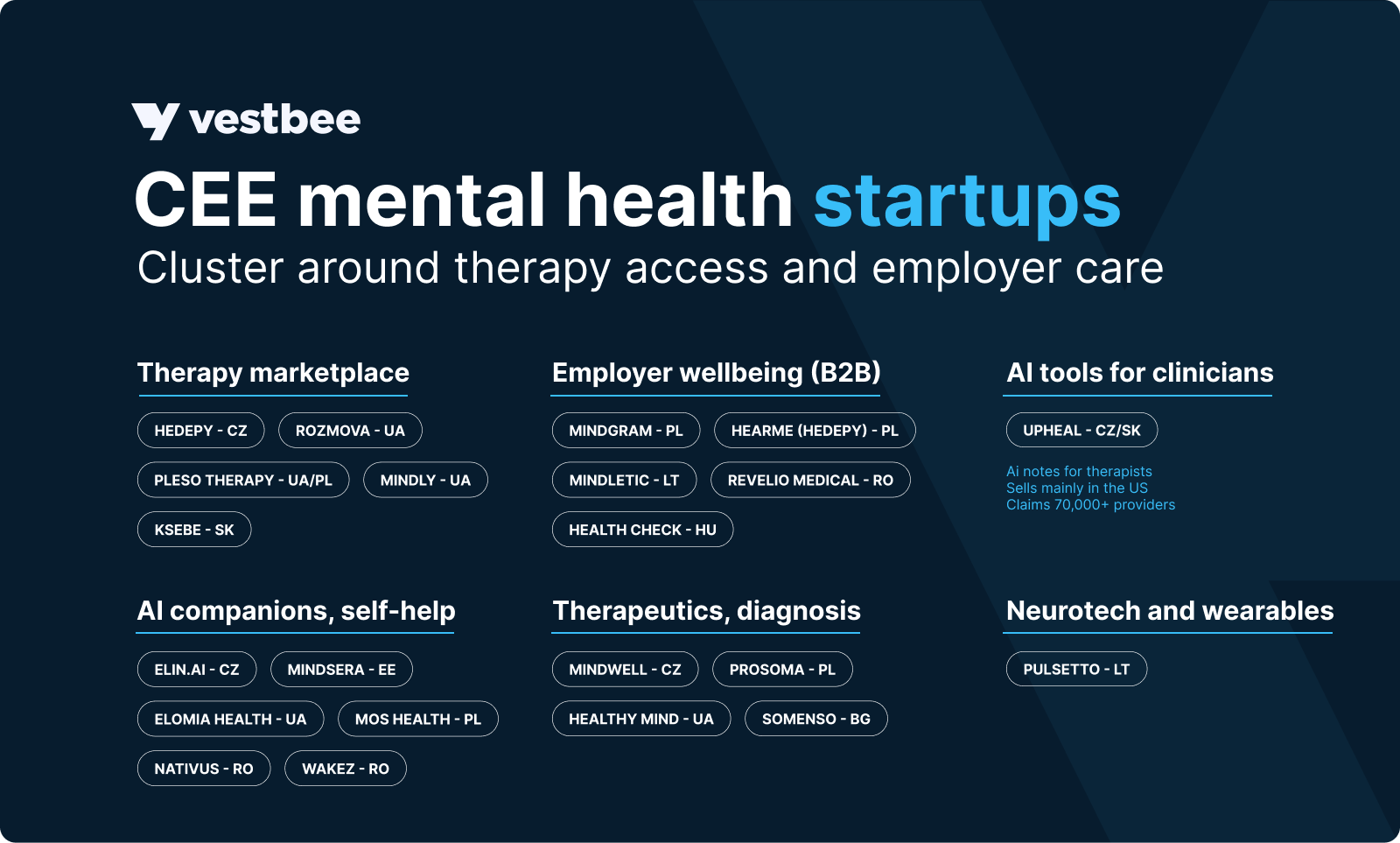
- Czech-Slovakian Upheal is building AI tools not for patients but for clinicians — taking the paperwork out of therapy. It transcribes sessions, drafts progress notes, and adds practice-management and telehealth features. In November 2024, it raised a $10 million Series A led by Headline, with Credo Ventures and Kaya VC.
- Prague-based Hedepy launched as an online psychotherapy marketplace in 2020 and has since shown that in fragmented, language-specific markets, growth through M&A and a strong B2B arm can beat chasing a mega-round. In September 2025, it acquired HearMe, a Polish workplace mental health platform, adding corporate clients and operating now in nine markets.
- Ukrainian founders have built some of the region's most export-minded companies. Pleso Therapy, founded in Ukraine in 2021 and now run from Warsaw, matches clients with therapists using an algorithm and sells to both individuals and employers. In February 2026, it raised $2.5 million through a convertible loan at a $30 million pre-money valuation, from investors including the ICLUB syndicate and former Kyivstar CEO Petro Chernyshov.
- Public reimbursement is also possible, but it takes evidence. Poland's Prosoma develops a digital therapeutic, Living Well, that targets anxiety, depression, and PTSD in cancer patients. It is reimbursed through more than 30 selective contracts in Germany and Switzerland, with early pilots in the US, and raised Series A funding from CRB Health Tech in 2025.
- Not all mental health innovation is software. Lithuania's Pulsetto, founded in 2021, makes a wearable that stimulates the vagus nerve to help with stress and sleep. In February 2025, it raised €2 million from Scalewolf to adapt the device for soldiers and first responders.
These companies show how technology can support clinicians and make therapy easier to access. Alongside these approaches, people are also turning to AI chatbots for emotional support. This raises questions about whether AI can help address the care gap and what evidence is needed to establish its role.
Can AI replace therapists?
Europe’s care gap raises questions about whether AI could make mental health support more accessible. US research offers some early context. A Pew Research Center survey published in June 2026 found that 10% of US adults had used chatbots for emotional support or advice, rising to 20% among 18–29-year-olds.
Investors in AI-first products point to the shortage of care. Forerunner Ventures, which backs AI therapy startup Slingshot AI, cites about 56 million Americans who sought therapy in 2022 against roughly 500,000 licensed behavioural health providers.
Clinical evidence for AI therapy is only beginning to be evaluated. Dartmouth’s trial of Therabot, a generative AI chatbot, found that over eight weeks, participants’ depression symptoms fell by an average of 51% and anxiety symptoms by 31%. The comparison group, however, was a waiting list rather than another treatment. The researchers cautioned that “no generative AI agent is ready to operate fully autonomously in mental health” and stressed the need for clinician oversight.
Alongside tools that offer support directly to patients, AI is also becoming part of professionals’ work. In a 2025 survey, 56% of US psychologists reported using AI at work, up from 29% a year earlier, including for tasks such as writing and administration.
Mental health startup funding in 2026: big rounds and consolidation
Mental health is still the most-funded clinical area in US digital health, a position it has held for seven consecutive years. Across the Atlantic, money goes to fewer, larger companies, mostly those paid by insurers rather than by consumers. In February 2026, psychiatry provider Talkiatry raised a $210 million Series D led by Perceptive Advisors, with a16z participating. A month later, therapy network Grow Therapy raised $150 million at a reported $3 billion valuation, led by TCV and Goldman Sachs Alternatives.
European rounds remain smaller: Dutch employee mental health platform OpenUp raised €20 million in March 2026, and UK-based JAAQ raised £13 million the same month.
2026 has also been a year of consolidation: Hospital operator Universal Health Services completed its acquisition of Talkspace, an online therapy provider, in August, at an enterprise value of about $835 million. Portugal-founded Sword Health agreed to buy Headspace for a reported 300 million in cash.
Why do so many mental health startups fail?
These deals show that mental health can attract substantial investment. But turning demand for care into a sustainable business remains difficult, and many startups have shut down along the way. An analysis of 542 digital mental health companies, cited by EU-Startups, found that 53% of those relying on consumers to pay had shut down or gone bankrupt.
Woebot, one of the best-known therapy chatbots, retired its app in June 2025 after raising $123.5 million, and its founder linked this failure to the cost of meeting FDA requirements. Another example is a voice-biomarker startup, Kintsugi, which closed in February 2026 before winning FDA clearance and open-sourced its models. Germany's Mika, an app for cancer patients with anxiety and depression, lost its place in the national app reimbursement scheme over a study registration issue, and with it, most of its revenue.
Kintsugi's CEO Grace Chang summed up the tension many founders face: “Venture investors still expect you to be at $100 million in ARR by year ten — and now… by year three or five. But in healthcare, you can't even sell your commercial product until you are FDA-cleared.”
Lessons for founders and investors in CEE mental health tech
The companies, funding rounds, and setbacks discussed above offer practical lessons for founders and investors in CEE. Demand for mental health care is substantial, but building a sustainable business also requires a clear payment route, evidence that the product works, and enough funding to reach the market.
For founders:
- Keep a human in the loop. Regulators, clinicians and buyers are far more comfortable with AI that supports professionals than with AI that replaces them.
- Plan the payment route early. Czechia's new pilot, Germany's DiGA scheme and NHS digital front doors show that reimbursement is possible, but each demands evidence.
- Design for the EU AI Act now. Transparency duties already apply, and emotion recognition at work is banned.
- Prepare for international growth. Upheal, Hedepy and Pleso all looked beyond their home market from the start.
- Treat evidence as a moat. With research showing modest effects across the board, products that can prove outcomes will stand out.
For investors:
- Assess the payer alongside the need. Rising sick leave, long waiting lists, and new reimbursement routes point to demand that capital has not yet matched.
- Match funding to development timelines. Kintsugi’s experience shows how clinical research and regulatory requirements can stretch beyond investors’ expectations of rapid growth
- Consider strategic buyers as a route to an exit. Hedepy's purchase of HearMe, the sale of Czech startup VOS.health to a US company, and Sweden's Mindler buying ieso's UK business show the consolidation path.
- Regulation cuts both ways. It raises the cost of entry, as Woebot and Kintsugi found, but it also protects the companies that clear the bar.