
European technological sovereignty has moved from a political concept to what many describe as a genuine driver of capital flows. At least that’s what founders and investors increasingly declare. But how real is that shift? Has Europe’s investment landscape truly changed, or are startups and funds simply relabelling what they were already doing?
Vestbee sat down with Adam Niewiński, co-founder and Managing Partner of OTB Ventures, one of Europe's most active deeptech investors, to talk about technological sovereignty, the region’s risk-averse investment culture, its evolving relationship with American technology, and why OTB has spent nine years building conviction in space, AI, and physical AI — long before either became fashionable.
European tech sovereignty has gone from a political slogan to a major investment theme. Has anything actually changed, or is it still mostly a matter of language?
A great deal has changed, and mostly in the last year and a half. Before that, very little was happening. But over the past eighteen months, there has been a clear shift in how politicians and institutions perceive this issue, and a lot of emphasis has been placed on it. There were two triggers: the war in Ukraine, and, just as important, the change of administration in the United States and the shift in how the US approaches Europe and the world.
For years, many European institutions and politicians treated it almost as an axiom that the US would keep sharing technology with Europe, would support it, and that the two were practically one coherent bloc. It turned out that the assumption was, to a large extent, wrong. That was a wake-up call.
As a result, debates about how to split the EU's agricultural budget suddenly look far less urgent than debates about how Europe builds its own technology and becomes independent of other powers. That shift has redirected significant EU funding, and NATO member states have committed to substantially higher defence budgets. Importantly, defence in this context is understood very broadly.
It's not just missiles, artillery, and tanks — increasingly, it means resilience and sovereignty across the board: cybersecurity, robotics, AI, but also AI infrastructure and energy infrastructure. These are all major beneficiaries of this new wave of funding, and we're only at the beginning of it, since governments have committed to increasing these budgets year after year.
That's the macro, policy-maker level. Does it actually reach founders? Are they building with resilience and sovereignty in mind, or is that narrative simply layered on top of what they'd be doing anyway?
Honestly, both things are happening. Some founders are genuinely inspired by this; they're thinking about where the technological gaps are and how to fill them, and we're seeing a lot more startups across CEE, and Europe more broadly in the resilience and security space.
But let's not pretend the rest isn't happening too. Some are using it as a shortcut, trying to fit into a fashionable theme because they know the money flows more easily there. If you're doing something interesting today in space and defence, broadly defined, financing is disproportionately easier to find than if you're building yet another marketplace.
We're literally seeing companies that used to build marketplaces now repositioning as "a marketplace for space and defence." Part of the market genuinely believes in this and is inspired by it; another part is doing window dressing, repainting what they were already doing, often with limited success, as resilience.
Where is this sovereignty thesis most visible today, and where do you expect it to matter most in the coming months?
For us, this comes down to three verticals:
- AI and novel computing.
These are models narrowly specialised for financial services, health tech or defence. Alongside that sits novel computing, the infrastructure that supports AI and goes beyond it. That includes semiconductor development, or in-memory computing. We think the current architecture of compute power is going to change. Quantum computing belongs here, too. We believe it's a question of when, not if, but it's still unproven technology commercially, so we watch it very closely without expecting near-term returns.
- Spacetech, where we're one of the two most active and experienced investors in Europe.
We started nine years ago, when there was essentially one other fund doing this; everyone else assumed we'd watched too much Star Wars while they built B2C apps, then marketplaces, then SaaS. Now everyone is trying to jump into deeptech, which is great, there's plenty of room, and money is always welcome, but a lot of them are tourists who know almost nothing about spacetech.
It takes years to understand this ecosystem and to build relationships with the European Space Agency and others that let you see where it's heading. Our first fund concentrated on Earth observation; in our second fund, we've moved further into in-space infrastructure, which is where we're finding more interesting targets today.
- Physical AI.
It includes genuinely intelligent robotics, not the old generation of machines that simply moved objects around, but systems that can operate intelligently on Earth or in space. We consider intelligent sensing part of this, too, such as radar, for instance. We've invested in a company building radar the size of an iPhone: the range is modest, around two kilometres, but it's small, cheap, and can be mounted on almost any asset or held in your hand, giving full situational awareness of the surrounding space. That has real relevance for counter-drone defence and air defence more broadly.
We also look, though we specialise less here, at energy technologies like fusion, and at "tech bio": using AI in pharma and healthtech rather than biology and cell chemistry directly.
You've been investing in deeptech since before it was fashionable. What has that journey looked like — from early conviction to a market that now desperately wants what you've been building?
We've done deeptech from day one, nine years now, on the premise that deeptech is Europe's fundamental strength, that spectacular B2C successes will be much harder to find here. Europe has very strong universities and a strong science base in technology; our STEM graduates feed not just Europe but the United States, too.
The biggest barrier, and I honestly don't have a perfect answer for how to fix it, is that Europe is deeply risk-averse — as individuals, as institutions, as corporations. There's no culture of taking risks, even though the entire world runs on the logic of risk and return: that naturally means more failures too, and Europe has far less tolerance for failure than the US does.
As a result, it's much harder to sell new technology to a European corporation than to an American one — European corporates don't want to be first, don't want to make a mistake, and don't want to work with what they see as risky startups. Often, they wait until a startup has proven itself with five American corporations before they'll even consider it. That makes it much harder to build innovation here, because companies that want to commercialise, to be close to their customers, end up following those customers to the US if that's where they are.
I think that's a bigger barrier today than financing, because the financing gap is closing fast — Europe has more capital for tech than ever, and American funds are perfectly happy to finance a European success story too; they're entirely pragmatic about it.
But over the last eighteen months, something has genuinely shifted in the European mindset. Where Europeans once assumed anything American was automatically better, and anything European was some lesser, that's changing remarkably quickly. Institutions and companies, especially in strategic sectors, increasingly don't want to buy American and would rather buy European. Palantir, for instance, is being displaced by European alternatives in several places because governments and institutions don't want their data flowing to, and being analysed by, US entities.
What would actually need to change — culturally, structurally — for Europe to shed that risk aversion?
I don't have a perfect diagnosis, but there's a growing sense that European isn't automatically worse. As an example, pension funds are starting to invest in technology, which is one sign of that. It's slow because the mentality is deeply rooted, but it's moving.
I'd bet on success stories like ICEYE. They build pride, and they prove tech investing isn't a reckless gamble best left to research institutes, but that it's some of the most profitable investing there is. My hope also lies in young people — fresh graduates who studied internationally, without the old mental baggage, will see these successes and lean into an entrepreneurial mindset rather than a bureaucratic one. But it takes work.
Politicians could do more to promote entrepreneurship. In the US, there's almost a cult of the entrepreneur; in Europe, the instinct is closer to "he probably schemed his way into it." We need to change that in how the state treats entrepreneurs and in education, where we simply don't train people to build companies. What we need is a mentality that accepts risk, accepts failure, and gets back up to try again.
You mentioned American protectionism — that means the US government thinks several times before buying a European solution. How does the reverse work? Are European governments becoming real customers for defence and space startups, and is that a meaningful factor for investment?
Absolutely, and this too is changing fast. Five years ago, if you'd asked me whether selling technology to governments was realistic, I'd probably have laughed and said it was next to impossible. But in just the last few years, ministries and state agencies have started to understand that you cannot talk seriously about national defence without cooperating with private companies that build cutting-edge technology. That's true at the national level and at pan-European institutional level too: there's been a major mindset shift at the European Commission, and at agencies like ESA.
We're not at American levels of openness yet, but the change over the last three to five years is genuinely significant, and if it continues at this pace, I'm optimistic about where Europe is heading.
Where does venture capital sit in this whole project of European sovereignty, security, and resilience? Is it still a marginal part of the economy, or is it central to how policymakers are thinking about this?
Whether politicians realise it or not, VC is the fundamental engine of this change, of generating innovation and technological development. Look again at the world's 10 or 20 largest companies: most are tech companies, and most were financed by venture capital at an early stage. That shows how enormous VC's role is.
Most of those examples are still American, but that will change too, as new European technology leaders will increasingly be financed by venture capital as well. That should give policymakers something to think about: who else is supposed to finance these companies at an early stage, if not VC?
OTB has recently backed Alta Ares, TYTAN Technologies, and Ingenix. Why these sectors, why these companies — and do they say something specific about OTB's investment thesis for 2026?
We focus on three verticals: space technologies, AI and novel computing, and physical AI, or smart robotics. We've always done deeptech, and now we're specialising further within these three, with clearer preferences inside each one. In space, we've never touched traditional launchers.
Early on, we decided we didn't want to compete directly with SpaceX, and it wasn't an area we felt strongly about. Our first fund leaned heavily into Earth observation; in the second, we've shifted toward in-space infrastructure, where we're finding the more interesting targets today.
Within defence, we're focused heavily on autonomous air defence systems — an area that urgently needs new technology and competencies that are scarce or simply don't exist yet in the market. Defence, for us, actually cuts across all three verticals: it touches space, AI, and physical AI alike, since intelligent robotics can be dual-use, and intelligent sensing, radar, for instance, sits within physical AI too.
A proper modern air defence system needs three layers:
- Detection: seeing the object and understanding what you're targeting and why, which is where intelligent sensing comes in.
- An analytical, AI-driven layer that decides how to respond: a swarm of small drones calls for a very different response than a fighter jet, so you need increasingly capable AI engines making that call fast and precisely.
- Interception: neutralising the threat, whether through an autonomous drone that kinetically knocks it off course, or, in military contexts, a warhead.
Matching the right instrument to the right threat, across all three layers, demands a very solid grasp of what's happening and very good analytics. Alta Ares and TYTAN are exactly this. We've also invested in MatrixSpace, which builds small, compact radar solutions. It's an area we're very active in.
If you had to bet on a single investment direction for the next five years, would it be defence, or are there other verticals you'd want to keep exploring?
Fortunately, we don't have to choose, so we're not going to — we stay focused on our areas of expertise within deeptech, and we think we understand it well.
I have a real conviction that in 10, 15, 20 years, spacetech may well become mainstream, no longer a niche for narrowly specialised investors like us, but an asset class everyone invests in, and we may move on to the next frontier by then. I don't think it's a good idea to be either too narrow or too broad.
In the past, investing in defence was still seen as reputationally risky. Now it seems almost fashionable, even from a PR standpoint. Any closing thoughts on that shift, and on sovereignty more broadly?
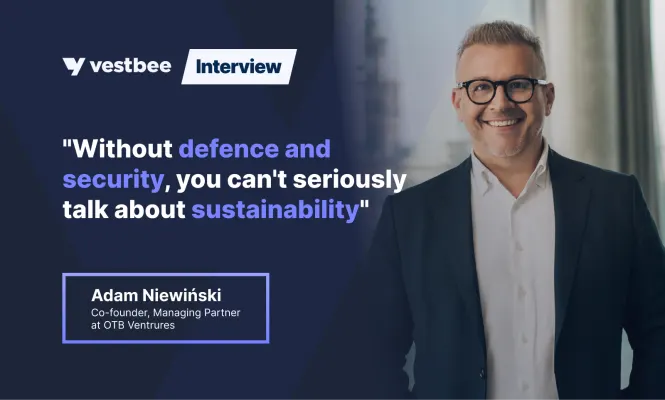
Here's how I see it: without defence and security, you can't seriously talk about sustainability at all. Only once you have security can you talk about democracy, about freedom, and growing prosperity. Only once prosperity is growing can you talk about things as important and necessary as, for example, climate tech.
It's a bit like Maslow's hierarchy of needs: security sits at the base, and it has to be defended and fought for. Everything else is valuable, important, even very important — but the foundation is security.