
Last December, PFR Ventures, Poland's state fund-of-funds, committed €46.3 million to four new VC vehicles to support local startups across stages. One of the selected funds was betacluster, which has raised €13.8 million to date and is targeting a second close at €19 million (PLN 81.25 million). The new firm focuses on early-stage Polish companies working with data and AI, and is built around a belief that, as AI tools become more widely available, long-term advantage will come less from the models themself and more from who controls and uses data effectively — the approach the team refers to as Smart Data Economy.
We spoke with betacluster's General Partners, Florian Steger, Gabriela Brodzińska-Drozd, and Cezary Iwan, about how they think about the Smart Data Economy and the fund’s role in the regional ecosystem.
How does the background of the betacluster team influence the types of founders and problems you are best equipped to support in Poland today?
Gabriela Brodzińska-Drozd: Our experience shapes our focus: globally oriented founders building disruptive, differentiated technologies poised to lead categories, especially where AI, deeptech, and data ecosystems create defensible advantages that reshape industries like manufacturing, logistics, smart health, fintech, smart cities, productivity, and security.
Our unique strength is international leverage. Our team has executed 90+ investments across Poland, Europe, Israel, and the US, and worked together for years investing on behalf of a leading European telco.
Now betacluster leverages this foundation, providing access to 70+ VC funds, venture partners from 10+ European countries, the US, and Asia, and a strong corporate network across leading tech companies. We open doors to early pilots, strategic partnerships, and follow-on investors, enabling Polish founders to become international category leaders faster.
betacluster frames its strategy around the Smart Data Economy. What does this mean in practical terms at the early stage?
G.B.-D: Smart Data Economy is our way of describing a structural shift: industries will compete on how effectively they produce, secure, govern, and operationalize data, because that’s what makes AI deliver real outcomes. In a world where AI capabilities are becoming more accessible, the durable edge moves earlier in the value chain, toward data ownership, data quality, compliance, and deployability.
For us, it means backing early-stage companies that have at least an MVP or prototype and a clear competitive edge-whether through proprietary data access, defensible architecture, or meaningful performance/cost advantages.
Many funds now describe themselves as "AI-first.| What makes your Smart Data Economy focus different in how you select and work with companies?
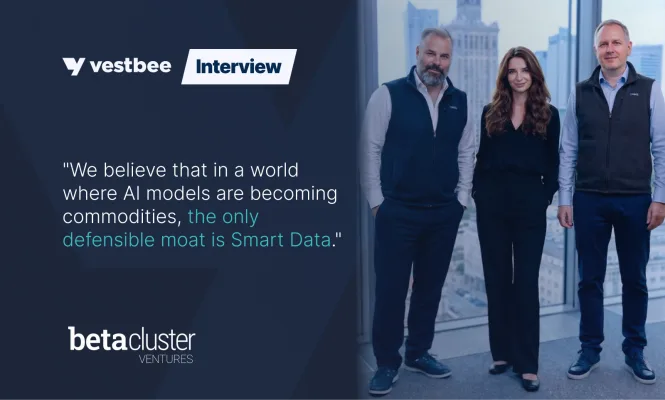
Cezary Iwan: While "AI-first" funds often focus on the engine (algorithms and models), at betacluster, we focus on the fuel (the data). We believe that in a world where AI models are becoming commodities, the only defensible moat is Smart Data: high-quality, secure, governed, and proprietary. We don't just look for companies using AI; we look for companies that are building the infrastructure to make data intelligent, safe, and actionable for AI to actually work in the real world.
Our Smart Data Economy approach starts earlier in the value chain — on how data is produced, structured, governed, and embedded in real industries. We back companies with proprietary data flows and real data advantages, not AI for AI’s sake, and care as much about infrastructure and enablers like data governance, security, edge computing, and 5G as we do about algorithms.
At the early stage, data advantages are often still unproven. How do you decide whether a startup’s data can become a real competitive advantage?
C.I: At the early stage, we don’t expect the data advantage to be fully formed, but we do expect it to be structurally plausible. We look at whether the startup is positioned at a natural data choke point: close to data creation, embedded in workflows, or integrated into systems that get richer with use.
We assess how data volume, quality, and uniqueness will improve through normal customer adoption rather than heroic assumptions, and whether switching costs, regulation, or technical integration can turn early access into a long-term moat. In short, we’re underwriting the trajectory of the data advantage, not just what exists on day one.
Poland has strong engineering talent, but scaling globally is still hard. Where do Polish AI founders struggle most, and how do you support them in closing those gaps?
C.I: Polish founders are exceptionally strong on engineering and problem-solving, but the hardest gaps usually appear when moving from a great product to a repeatable global business.
We most often see challenges around enterprise go-to-market, pricing, and packaging for international customers, and selling into regulated or conservative markets where trust, references, and local presence matter as much as technology.
Our role is to close those gaps early: pressure-testing the commercial story, shaping the product around real buyer workflows, and actively helping with first international pilots, design partners, and strategic hires. We’re very hands-on in turning technical excellence into something that scales commercially beyond Poland.
You describe a broad "smart money" approach that spans fundraising and strategic support. Which parts of that support matter most in the first year, and where do founder expectations most often differ from reality?
Florian Steger: In the first year, the most impactful support is investment-related: helping founders prepare early and deliberately for future rounds by sharpening the right KPIs, building a credible and scalable equity story, and making targeted, high-quality introductions to relevant investors. Closely linked to that is expanding our international partner network, whether for market entry, first-reference customers, strategic partnerships, or fundraising beyond the home market.
Operational support matters too, but typically on a clearly defined “when needed” basis rather than as a constant intervention, so founders can build and learn on their own.
Where expectations often differ from reality is that smart money is not about investors “knowing better” or dictating decisions, but about being a trusted sparring partner and coach — someone founders can think aloud with, challenge assumptions safely, and gain new impulses they might not get elsewhere.
Several of your focus areas involve long sales cycles and regulatory complexity. How does this influence your expectations from startups around early traction and progress?
F. S: Our expectations around early traction are less about immediate revenue and much more about choosing the right fight at the right time in a complex environment. We look for clear thinking on what can realistically be proven early — whether that is the robustness of the core technology, evidence that a real customer problem is being solved, regulatory feasibility, or the ability to scale a specific part of the model. Especially at an early stage, it’s not about solving all problems in parallel, but about deliberately de-risking the venture step by step with focus and discipline. What matters most is the ability to clearly define, test, and prove key hypotheses about the business, and to show investors and customers that the team can execute reliably on its promises as complexity increases.
Looking five years ahead, what would success look like for betacluster’s impact on the Polish startup ecosystem?
F. S: Success for us would mean that significantly more international venture capital from Europe and the US is actively co-investing in and following on into startups from Poland. We want Poland to be clearly recognized as a place where startups can compete globally and serve customers in international markets from day one. Another key marker of success is attracting and retaining world-class founders, operators, and investors who consciously choose the Polish ecosystem. Ultimately, it would mean a shared belief that Poland is the best place in Europe right now to build ambitious, globally relevant companies.


